

Last year Mary Taylor of the South West Society of Botanical Artists (SWSBA) wrote a piece for our website detailing the Quantock Hills Botanical Art Project.
Launched in 2024 it, initially, focussed on plant species found on the hills. It has since expanded to include butterflies and we’re delighted to share with you four works that focus on the hairstreak species that are found, or have been found, in and around the local area. Huge thanks to Mary and to fellow SWSBA member, Angie Girling for allowing us to use their artwork.
Mary has also put together a lovely summary of each species, including information on when to see them and where to look as well as information on their life cycle and feeding habits.
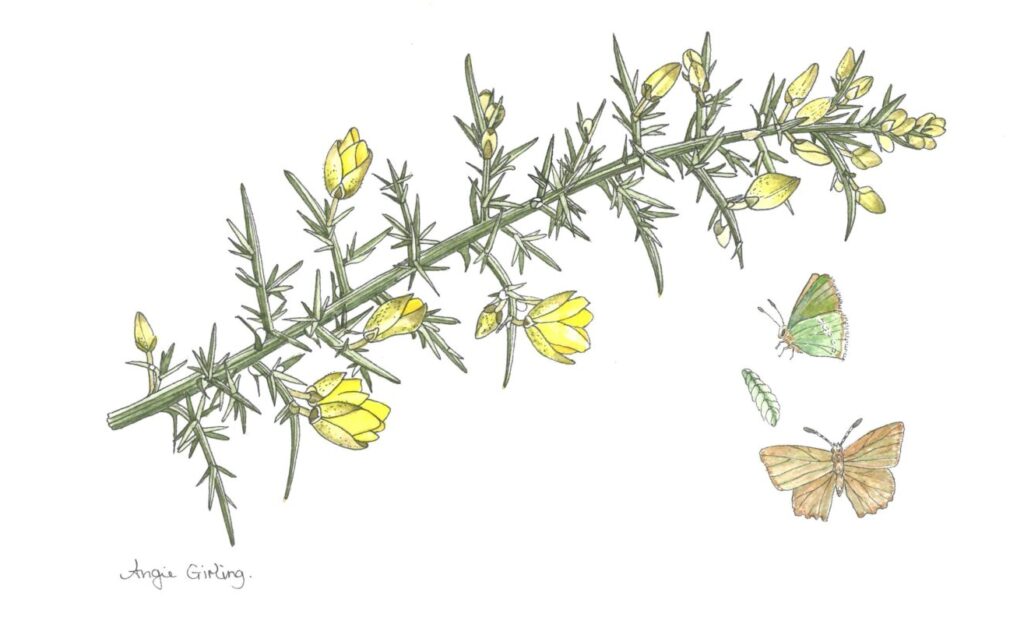
The Green Hairstreak is our only green butterfly, the adults emerge in late April and through May. They can often be seen sunning themselves on gorse on the top of Quantock Common and seek nectar from a range of plants including bird’s Foot Trefoil and bramble. They lay their greenish coloured eggs singly on the young growth of gorse bushes or bilberry, The eggs hatch into caterpillars after 7 to 10 days, these feed on the buds and young leaves of their host plant; the caterpillar’s are also cannibalistic. They pupate in August and the pupa remains in the leaf litter for 8 to 10 months until late spring the following year when the adult butterfly emerges. The pupa can make squeaking sounds that are attractive to ants. The Green Hairstreak is the only species of hairstreak butterfly to overwinter as a pupa.
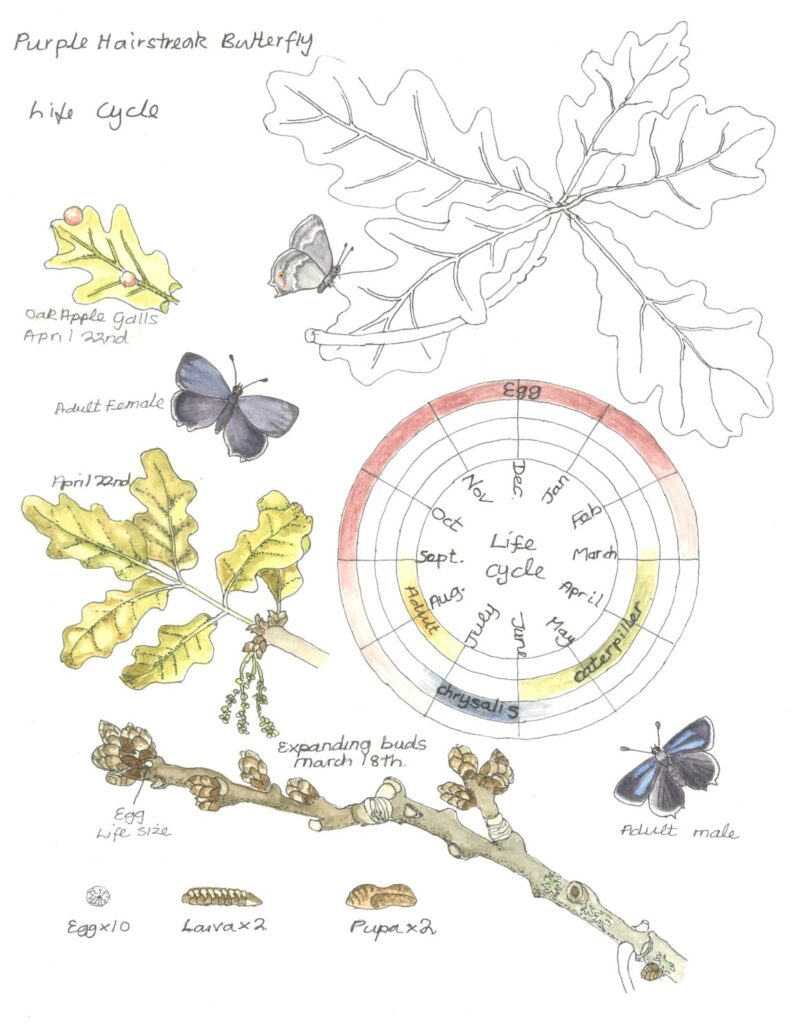
The Purple Hairstreak butterfly spends its entire life cycle in oak trees. Historically the coppicing of oaks was an important industry producing both bark for tanning and charcoal for iron working. These iridescent purple butterflies emerge in July through to September. They have a wing span of 3 to 4 cm and spend their brief lives flying high in the leaf canopy feeding on honeydew and, as such, are very hard to spot! The butterflies lay their eggs individually at the base of the terminal oak buds where they overwinter. The caterpillars hatch in early spring the following year and immediately bore into the swelling buds feeding on the developing flowers and leaves. The small caterpillars resemble an expanding leaf bud, feeding at night to avoid day-time predation. They pupate in July in the leaf litter under the oak trees, emerging as adults in August . This stunning little butterfly is thought to be wide-spread in oak woodland on the Quantocks but is under-recorded as it is so hard to spot; however 10 were seen in 2025.
The White-letter Hairstreak butterfly has recently been rediscovered on Wych Elm growing in several locations on the Quantocks. These host trees have to be large enough to produce flowers. In the 1970s, elm species were devastated by an outbreak of Dutch Elm Disease. However, Wych Elms have survived as ‘hedgerow shrubs,’ mainly growing from root suckers. These suckers can grow for about 20 years forming small trees. Sadly, most of them will eventually succumb to Dutch Elm Disease once their girth increases. White-letter Hairstreak butterflies emerge in June through to mid-August.
They spend most of their lives flying high in trees growing in the hedgerow. They occasionally descend to the ground to gather nectar from bramble, thistle, fleabane or hemp agrimony plants. The adults lay their eggs on elm twigs, these over winter and hatch early the following spring when the elm buds are opening. The caterpillars burrow into the buds feeding on the developing elm flowers and on the young leaves and are well camouflaged. They pupate in late spring and the pupa are attached to the underside of a leaf or an elm twig by a thread of silk. The adult butterfly emerges a couple of months later in June & July.

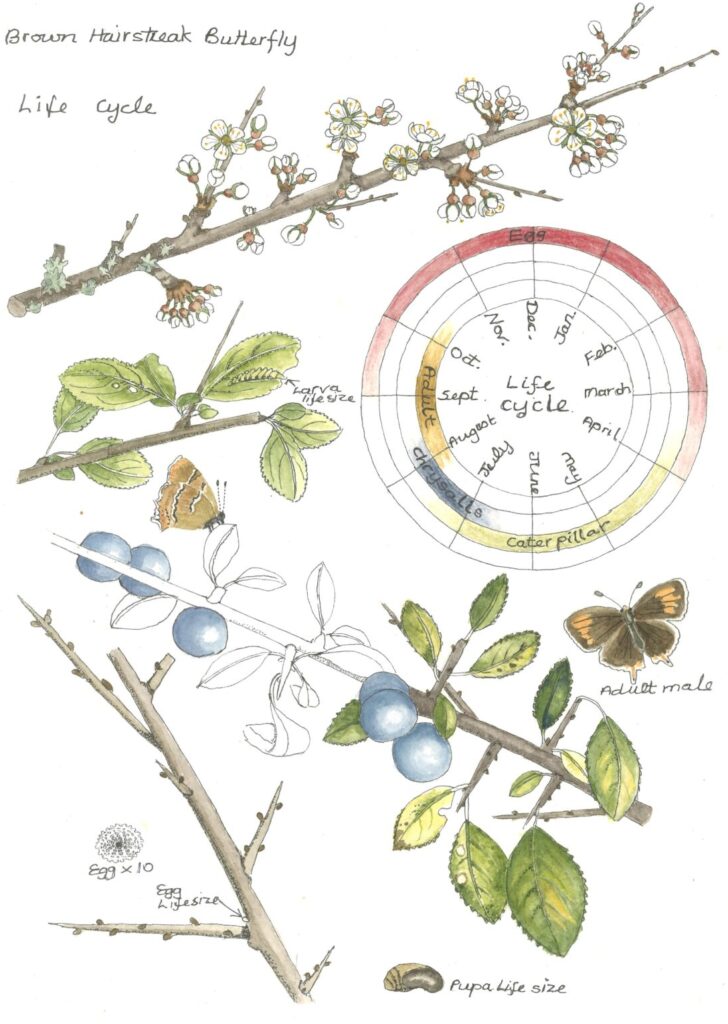
The Brown Hairstreak is the largest of the Hairstreak butterflies with a wing-span of 3.6 to 4.5 cm. The host plant for this species is mature blackthorn growing in scrub or hedgerows. The butterflies emerge in August through to September and spend most of their lives high in the hedgerows or in the tops of ‘master trees’, usually ash growing nearby where they feed on honey-dew. Adult butterflies are occasionally seen flying near mature blackthorn hedges on the Quantocks. The adults usually lay a single lay egg on young blackthorn shoots usually in the axil between the shoot and a thorn, but occasionally multiple eggs can be found…possibly from multiple butterflies. These eggs are white and the size of a pin head and look like miniature sea urchins. The eggs are found by examining blackthorn shoots in the winter when they are easier to see. The eggs hatch out in April the following year as the blackthorn leaves open. The caterpillars are the same green colour as the young leaves and are well camouflaged; they pupate in July and drop to the ground where they are hard to find, the adult butterfly emerges a month later. Farming practices have led to a significant loss of habitat, not only were hedge rows grubbed out, but those that remain are flailed in the winter destroying the young growth where the eggs have been laid. The success of this species is dependent on sympathetic management of blackthorn hedges.
There is a great opportunity to see the work of the SWSBA from the 22nd September until 2nd October at Taunton Library. To find out more about SWSBA, their work and upcoming events click here